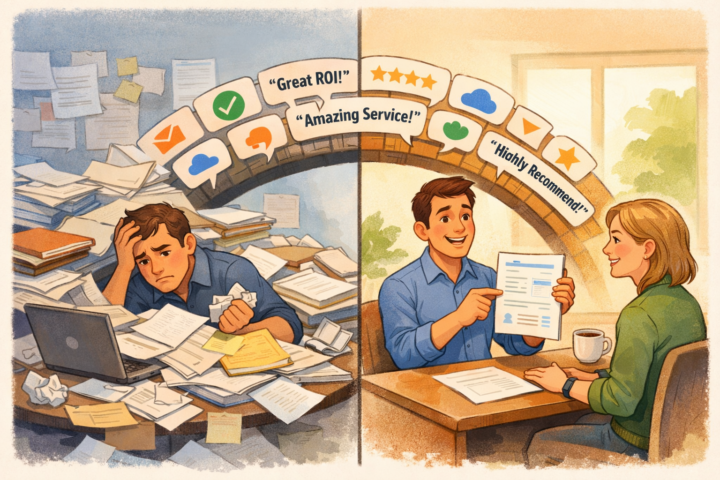

It’s 4:47 PM on a Thursday. Your top sales rep pings you on Slack:
“Hey, I need a reference in healthcare—preferably enterprise, ideally someone who’s used our analytics module. The prospect wants to talk tomorrow morning. Can you help?”
Sound familiar?
What follows is a frantic scramble. You dig through old emails. You ping the Customer Success team. Someone remembers a contact at a healthcare company, but they’re not sure if that person is still there—or still happy. By the time you find someone willing to take the call, the prospect has gone dark.
This isn’t a rare occurrence. It’s the status quo at most B2B companies. And it’s costing you more than you realize.
The True Cost of Ad-Hoc Reference Hunting
When references are managed reactively—scrambled together at the last minute from spreadsheets, memory, and email threads—the consequences ripple across your entire revenue organization.
Deals Stall at the Finish Line
Research from Revenue Operations case studies shows that reference assets like testimonials and peer calls can boost deal velocity by 20-30%. But that only works when references are available on demand.
When a prospect asks for a reference and you can’t deliver within 24-48 hours, momentum dies. The buying committee moves on to other priorities. Competitors who can produce a relevant reference swoop in. What should have been a closed deal becomes a “we’ll circle back next quarter”—or worse, a loss.
The math is brutal: if your average deal is worth $50,000 and delayed references cause even a 10% slip rate, you’re leaving hundreds of thousands on the table annually.
Your Best Advocates Get Burned Out
Here’s the irony of the scramble: because finding references is so hard, sales teams default to the same handful of customers over and over. That one enthusiastic VP of Operations who always says yes? She’s getting called five times a month.
Eventually, even your most loyal advocates start declining. They stop responding to emails. They ask to be removed from the list entirely. You’ve burned out your best asset—not because they stopped believing in your product, but because you didn’t protect their time.
Reference fatigue is real, and it’s preventable. But only if you have visibility into who’s being asked, how often, and by whom.
Hidden Labor Costs Add Up
Think about what actually happens during a reference scramble:
- Sales rep stops selling to hunt for a reference
- Sales rep messages Customer Success asking for names
- CS manager digs through their accounts to find candidates
- Someone emails or calls the potential reference
- Back-and-forth to find a time that works for everyone
- Confirmation and prep for the call
Conservative estimate? That’s 2-3 hours of labor spread across multiple people—per reference request. Multiply that by dozens of deals per quarter, and you’ve got a full-time employee’s worth of effort buried in coordination overhead.
That’s not just inefficient. It’s expensive.
You’re Flying Blind on What Works
When references happen ad-hoc, you lose all ability to measure their impact. Which references actually helped close deals? Which industries or personas convert best after a peer call? Are video testimonials outperforming live conversations?
Without a system, the data lives in inboxes and Slack threads—if it exists at all. You’re guessing instead of optimizing. And in a world where 80-85% of B2B purchases are influenced by references (according to Gartner), guessing is a competitive disadvantage.
Why This Problem Persists
If the costs are so high, why do most companies still manage references this way?
“We Don’t Have Enough References to Justify a System”
This is backwards. You don’t have enough references because you don’t have a system. Without structure, recruiting new advocates feels like yet another ad-hoc task that falls through the cracks. A proper program makes it easy to identify candidates, track who’s agreed to participate, and expand your pool over time.
“Our CRM Handles It”
Your CRM is built for deals, not advocates. Sure, you can add a custom field or tag—but that doesn’t give you availability tracking, usage limits, matching logic, or any of the other capabilities you need to run references at scale. The CRM becomes another spreadsheet, just with better branding.
“Customer Success Owns This”
Maybe. But CS is measured on retention and expansion, not on producing references for sales. Without clear ownership, shared visibility, and a process that respects everyone’s time, references become a hot potato that nobody truly owns.
What a Structured Reference Program Looks Like
The companies that win deals faster have moved beyond the scramble. Here’s what they do differently:
Centralized, Searchable Reference Library
Every customer who’s agreed to be a reference lives in one place—with their industry, company size, use case, and contact preferences attached. When a rep needs a healthcare reference with analytics experience, they can find one in seconds instead of hours.
Visibility Into Availability and Usage
Smart programs track how often each reference is contacted and set limits to prevent burnout. They also let advocates control their own availability—so you’re never asking someone who’s swamped or on vacation.
Self-Service for Sales
Instead of sales reps playing telephone with CS, they can browse available references directly and see who matches their prospect’s profile. Some companies even let prospects browse references themselves through a branded portal—removing the gatekeeper entirely.
Closed-Loop Analytics
When you can tie reference activity back to deal outcomes, you can finally answer the important questions: Which references are most effective? What’s the ROI of your advocacy program? Where should you invest to grow your reference pool?
The Bottom Line
Every day you operate without a structured reference program, you’re accepting slower deal cycles, burned-out advocates, invisible costs, and missed opportunities to learn what actually closes deals.
The companies treating references as a strategic asset—rather than a last-minute scramble—are pulling ahead. They’re closing faster, protecting their customer relationships, and building a competitive moat that’s hard to replicate.
The question isn’t whether you can afford to formalize your reference program. It’s whether you can afford not to.
Ready to stop scrambling and start scaling your reference program? See how Lyynx can help →