The playbook that built the last generation of B2B companies is showing cracks.
Paid acquisition costs keep climbing. Outbound response rates keep falling. The channels that once delivered predictable pipeline—ads, cold email, SDR armies—are hitting diminishing returns.
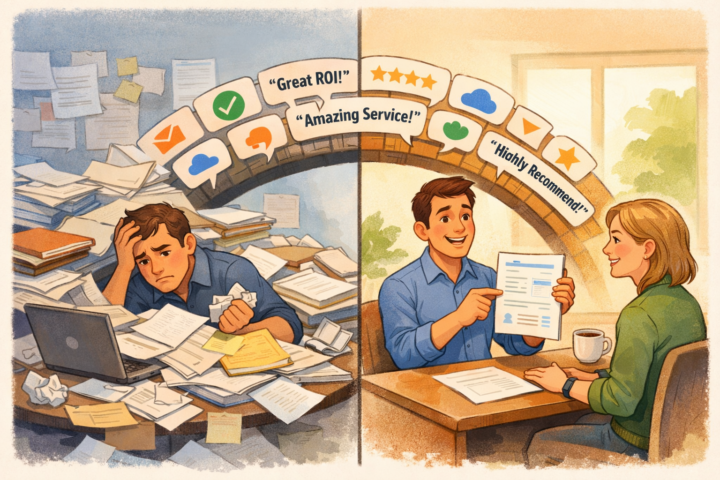
Meanwhile, something interesting is happening at the fastest-growing companies: they’re winning deals because their customers are doing the selling for them.
Welcome to Customer-Led Growth.
What Is Customer-Led Growth?
Customer-Led Growth (CLG) is a go-to-market strategy that puts existing customers at the center of how you acquire, convert, and expand revenue. Instead of relying primarily on marketing campaigns and sales outreach to drive growth, CLG companies leverage their happiest customers as the primary engine.
This isn’t just “word of mouth” rebranded. It’s a systematic approach that includes:
- Customer references that accelerate deal cycles
- Peer reviews on sites like G2, Capterra, and TrustRadius
- Case studies and testimonials that build credibility at scale
- Community engagement where customers help prospects and each other
- Referral programs that turn advocates into a distribution channel
CLG doesn’t replace traditional marketing and sales. It amplifies them. When a prospect sees your ad and reads a glowing review and talks to a peer who loves your product, conversion rates compound.
Why CLG Is Gaining Momentum Now
Several forces are pushing B2B companies toward customer-led strategies.
Buyer Behavior Has Changed
Today’s B2B buyers do 70% or more of their research before talking to sales. They read reviews. They ask peers in Slack communities and LinkedIn groups. They trust third-party validation more than vendor claims.
If your customers aren’t visible during that research phase, you’re losing deals before you even know you were in the running.
Acquisition Economics Are Broken
CAC (customer acquisition cost) has increased 60%+ over the past five years for many B2B categories. Paid channels are saturated. Inboxes are flooded. The cost to acquire a new customer through traditional means keeps rising while the returns shrink.
Customer-driven acquisition—references, referrals, reviews—has fundamentally different economics. The “media cost” is zero. The conversion rates are higher. And satisfied customers don’t burn out like ad budgets do.
Trust Is the Scarcest Resource
We’re drowning in marketing messages. Every product claims to be “AI-powered,” “enterprise-ready,” and “loved by customers.” Buyers have learned to tune it out.
What cuts through? Real people vouching for real results. A prospect will forget your tagline, but they’ll remember the conversation where a peer said, “This product changed how our team operates.”
References: The Most Undervalued CLG Asset
Within the CLG toolkit, customer references might be the most powerful—and the most neglected.
Think about it: a reference call is the highest-trust interaction in the entire buying process. It’s a real customer, speaking candidly, answering whatever questions the prospect has. No script. No spin. Just peer-to-peer validation.
According to Gartner, references influence 80-85% of B2B purchase decisions. Deals with strong reference support close 20-30% faster. Prospects who speak with references convert at significantly higher rates than those who don’t.
And yet, most companies treat references as an afterthought—something to scramble for when a deal is on the line, rather than a strategic asset to cultivate and deploy.
Why References Stay Undervalued
They’re invisible in attribution. Marketing can measure ad clicks and email opens. Sales can track calls and demos. But the reference call that sealed the deal? It rarely shows up in the CRM as a conversion driver. What doesn’t get measured doesn’t get invested in.
They’re operationally painful. Finding the right reference, coordinating schedules, preventing burnout—it’s all manual work that falls between teams. Nobody owns it, so nobody optimizes it.
They feel like favors. Asking a customer to take a call feels transactional. Companies are hesitant to “bother” their best accounts, so they under-utilize them—or burn out the few who always say yes.
The ROI is assumed, not proven. Everyone knows references help close deals. But without systems to track which references contributed to which outcomes, it’s hard to make the business case for investing in a formal program.
Unlocking References as a Growth Asset
The companies treating references as a strategic advantage—not a scramble—are doing a few things differently.
They Measure Reference Impact
You can’t optimize what you don’t measure. Leading companies track:
- How many deals included a reference interaction
- Win rates for deals with references vs. without
- Which references are most effective (by industry, persona, use case)
- Time-to-close differences when references are deployed early vs. late
With Lyynx, reference activity connects back to deal outcomes. You can finally see which advocates are moving the needle and where to focus your program.
They Build a Diverse Reference Pool
Relying on the same five customers for every reference call isn’t sustainable—and it limits your effectiveness. A healthcare prospect wants to talk to someone in healthcare. An enterprise buyer wants to hear from another enterprise.
Smart programs proactively recruit references across industries, company sizes, use cases, and regions. The goal is coverage: no matter what prospect walks in the door, you have a relevant peer ready to vouch for you.
Lyynx makes this manageable with smart tagging and filtering. Sales can search for references by any criteria—industry, product, company size—and find matches in seconds instead of days.
They Protect Advocate Relationships
Your best customers are a finite resource. Overuse them, and they’ll stop responding. Worse, you’ll damage the relationship that made them advocates in the first place.
Sustainable programs track usage, set limits, and distribute requests across the pool. They also give advocates control—letting them set availability, choose which prospects they’ll talk to, and opt out when they need to.
Lyynx has this built in. Advocates manage their own preferences. Usage tracking prevents burnout. And everyone—sales, CS, marketing—has visibility into who’s being contacted and how often.
They Make References Self-Service
The traditional model—sales asks CS, CS tracks down a contact, someone coordinates schedules—is slow and doesn’t scale. Every handoff introduces delay.
The CLG model flips this. Prospects can browse available references themselves, filtered by their criteria. They find someone relevant and book time directly. No gatekeepers. No waiting.
Lyynx’s public portal does exactly this. Prospects can explore your reference library, save favorites, and connect—on their timeline, not yours. It’s the difference between a week-long coordination process and a same-day conversation.
They Create Leverage Beyond 1:1 Calls
Reference calls are powerful, but they’re also expensive in terms of advocate time. Each call helps one prospect. The smartest programs multiply impact by capturing reference content that scales:
- Video testimonials that prospects can watch on demand
- Written Q&As that capture the reference story once and share it infinitely
- Success metrics that quantify results without requiring a live conversation
Not every prospect needs a call. Many just need to see that someone like them succeeded. By building a library of reference content, you satisfy more prospects while protecting your advocates’ time.
Lyynx supports video testimonials, company profiles with success metrics, and a centralized library—all searchable and accessible to both your team and your prospects.
The Compounding Effect of Customer-Led Growth
Here’s what makes CLG so powerful: it compounds.
A great reference helps close a deal. That new customer becomes a future advocate. They contribute reviews, testimonials, and reference calls that help close more deals. Each cycle expands your advocate base and strengthens your market position.
Traditional acquisition is linear: spend more, get more (until the channel saturates). Customer-led growth is exponential: the more customers you succeed with, the easier it becomes to win the next one.
But this only works if you treat your reference program as infrastructure—a system that continuously recruits, organizes, and activates advocates. If references stay an ad-hoc scramble, you never get the compounding effect.
From Cost Center to Growth Engine
Most companies file “reference management” under administrative overhead. Something the CS team handles. A checkbox for sales enablement.
CLG companies see it differently. References aren’t overhead—they’re a growth engine with some of the best economics in your GTM stack:
- Lower CAC: Peer-driven conversion costs less than paid acquisition
- Higher win rates: References build trust that no pitch deck can match
- Faster cycles: Validated buyers move through the funnel quicker
- Better retention: Customers who were referred or reference-influenced tend to be better fits
When you measure references this way—as a contributor to pipeline and revenue, not just a support function—the investment case becomes obvious.
The Bottom Line
The companies winning in B2B right now aren’t just the ones with the best product or the biggest ad budget. They’re the ones who’ve turned their customers into a growth channel.
Customer references are the highest-leverage, lowest-cost asset in that strategy. But only if you treat them as an asset—not a last-minute scramble.
The question isn’t whether your customers can help you grow. It’s whether you’ve built the system to let them.
lyynx is the customer reference management platform built for Customer-Led Growth. Centralize your advocates, empower self-service, and turn happy customers into your competitive advantage. See how it works →